

 au
au
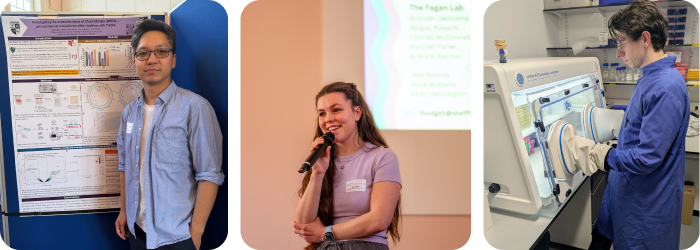
Don Whitley Scientific (DWS) were pleased to award three Travel Grants ahead of the 3rd annual Cross Channel Clostridioides difficile Forum (3CdF), held at Leiden University in the Netherlands in June 2026.
The DWS Travel Grant scheme helps early-career researchers attend scientific meetings where they can present their work, exchange ideas with peers and experts, and build valuable professional networks.
Representing DWS at the meeting was Technical Sales Specialist Stuart Moore, who exhibited our Whitley Anaerobic Workstations and met many researchers using our equipment in their laboratories. He had the pleasure of seeing each of our Travel Grant recipients present their research in person, highlighting the breadth of innovative C. difficile research currently taking place across Europe.
This year's recipients were:
- Basil Fok, PhD student at the University of Warwick, whose research investigates interactions between C. difficile and Phocaeicola (Bacteroides) vulgatus in dual-species biofilms.
- Will Channell, Research Assistant at the University of Warwick, who presented research exploring the role of MUC13 during Clostridioides difficile infection.
- Lilia Hodge, PhD researcher at the University of Sheffield, whose work focuses on the stringent response in Clostridioides difficile.
Below, each recipient shares more about their research, their experience at the conference, and what receiving a DWS Travel Grant meant to them.
Basil Fok
Understanding interactions between C. difficile and the gut microbiota
Basil's research focuses on the molecular mechanisms underlying interactions between Clostridioides difficile and Phocaeicola (Bacteroides) vulgatus within dual-species biofilms. By using Transposon-Directed Insertion Site Sequencing (TraDIS), his work aims to identify genes that are essential for C. difficile survival in mixed-species biofilms, helping researchers better understand how dominant gut microbiota can suppress C. difficile colonisation.
Throughout his research, Basil uses the Whitley A35 Anaerobic Workstation to culture strict anaerobes, perform C. difficile mutagenesis and conduct in vitro infection assays.
Reflecting on the conference, Basil described the opportunity to present his research as an invaluable experience.
"Attending the 3Cdf Conference in Leiden was a truly enriching experience. I had meaningful conversations with leading experts, gained new scientific and career insights, and connected with fellow PhD students and researchers from institutions across Europe. Without the DWS Travel Grant, it would have been much more difficult to expand my professional network and build collaborations within the C. difficile research community."
View Basil's research poster →
Will Channell
Investigating the role of MUC13 in Clostridioides difficile infection
Representing research from Professor Meera Unnikrishnan's laboratory at the University of Warwick, Will presented work investigating the role of MUC13, a transmembrane mucin protein found in the human gut.
The project combines both in vitro and in vivo approaches to understand how MUC13 influences Clostridioides difficile infection, improving our understanding of host-pathogen interactions and supporting the development of future treatments. These experiments rely on the controlled anaerobic environment provided by the Whitley A35 Workstation.
Speaking about the conference, Will highlighted both the scientific value of the meeting and the opportunities it provided to connect with researchers from across Europe.
"The meeting was a great opportunity to learn from and network with researchers working in similar research areas around the continent. I am incredibly grateful to Don Whitley Scientific for the financial support that made it possible for me to attend."
Will also thanked his supervisor, Professor Meera Unnikrishnan, and postdoctoral researcher Thomas MacCreath for their support throughout the project.
Lilia Hodge
Exploring the stringent response in Clostridioides difficile
Lilia's PhD research investigates the stringent response, a bacterial signalling pathway that enables bacteria to adapt to stresses such as starvation, oxidative stress and antibiotic exposure.
Although this pathway is widely conserved across bacteria, it remains relatively understudied in Clostridioides difficile. Using the Whitley A35, Lilia is able to maintain the stable anaerobic conditions needed to study highly sensitive mutant strains with confidence, ensuring environmental fluctuations do not influence her results.
For Lilia, the conference represented an exciting milestone in her research journey.
"I gave my first ever oral presentation at a conference and was able to receive advice and feedback from experts across a variety of areas of C. difficile research."
She also reflected on the wider impact that receiving the DWS Travel Grant had on her confidence as an early-career researcher.
"The European C. difficile community is small, but extremely kind and supportive. Receiving a travel grant not only helps me share my work, but assures me that I am worth investing in. As a PhD student it's easy to give in to imposter syndrome, and it's opportunities like this that help combat it."
Lilia also thanked Don Whitley Scientific for supporting her attendance and helping make her first conference presentation such a positive experience.
Scientific conferences provide researchers with far more than an opportunity to present studies. They encourage collaboration, spark new ideas and help early-career scientists develop confidence within their research communities.
The DWS Travel Grant was established to support exactly these opportunities, enabling researchers to share their work, build professional networks and contribute to the advancement of microbiology.
Congratulations again to Basil, Will and Lilia on their excellent research, and thank you for sharing your experiences with us. We look forward to following the progress of your work in the future.




 England